Oświęcim
The Glass RoomOświęcim is named at the novel’s turning point from the closure of the biometric centre in Landauer House to the machinery’s wartime redeployment. When the centre is dismantled, its Hollerith machines are loaded onto trucks for a new camp complex near Oświęcim. The place thus marks the machinery’s departure from an abandoned research project and its transfer into a system of persecution and mass imprisonment.
The Machines’ Destination
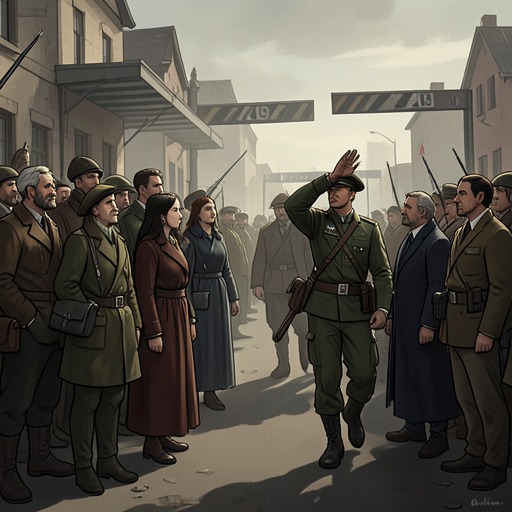
The biometric centre closes after the Reich Protector’s office judges its research unjustified: its scientists have failed to produce a scientific means of distinguishing Nordic, Slav, and Semitic people. Personnel leave for Berlin, Jena, and Leipzig; instruments, furniture, and files are dispersed. The Hollerith machines follow a different route. Technicians unscrew them from the garage floor and send them to an undertaking expected to make more fruitful use of them: the camp complex being established in Silesia near Oświęcim.
From Classification to Camp Administration
The destination gives the machines’ earlier presence in the house a disturbing retrospective force. In the biometric centre, the machinery belonged to a project that sought to render racial categories measurable, despite its failure to provide the desired scientific proof. Its transfer does not mean that the project has succeeded on its own terms; instead, the narrative emphasizes that equipment and documentation can outlast the institution and research rationale that first gathered them. The machines’ onward movement links the Nazi effort to classify people with the expanding camp system.
A Place in the Novel’s Spatial History
Landauer House changes from a private modernist home into a centre for racial measurement, then closes and later serves as a children’s gymnasium. Oświęcim enters this sequence not as another interior the novel describes, but as the destination toward which the centre’s machinery is carried. The contrast is stark: the house’s successive uses make visible how political power remakes lived space, while the trucks’ departure shows how the apparatus assembled there can be removed and redeployed elsewhere. Oświęcim consequently stands at the far end of the house’s transformation, where the instruments of classification are directed toward a camp complex.